Historic gardens and shady refuges in Palma
Palma is a Mediterranean city that learned early on to defend itself from the sun. Long before awnings and air conditioning, it organised its life around shade: the Andalusi water that ran through channels and fountains, the trees that roofed its promenades, the walled orchards that cooled its palaces. To walk its historic gardens today is not only to escape the heat; it is to read how different civilisations —Muslim, Christian, Enlightenment— understood greenery inside the city. This is a guide to those refuges.
S'Hort del Rei, the king's orchard
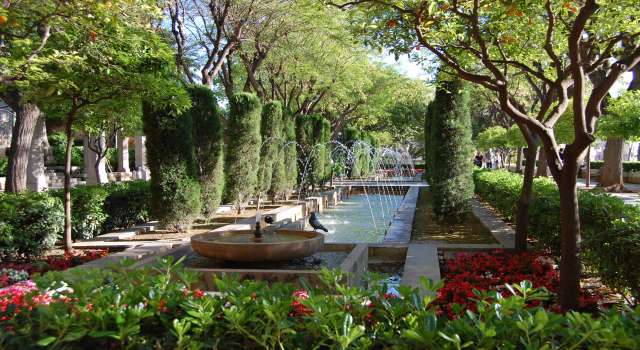
No garden tells that story better than S'Hort del Rei, at the foot of the Almudaina and the Cathedral. Its origins go back to the early fourteenth century, when it was the most important orchard of the Royal Castle of the kings of Mallorca: an enclosed space where fruit trees, flowers and vegetables were grown. The garden you walk through today is much later, the work of the architect Gabriel Alomar, who in the mid-twentieth century laid out three adjoining gardens to reconcile Hispano-Muslim, Italian Renaissance and Mallorcan gardening traditions. The central one, inspired by the Generalife's Jardín de la Acequia in Granada, is an avowed homage to al-Andalus: terraces, fountains and springs water hackberries, chinaberries and tall silk-floss trees, and integrated sculptures appear among the greenery, such as Subirachs's Jònica or a mobile by Alexander Calder. It is free and open for most of the day —you can read more on the S'Hort del Rei listing from the Balearic tourist board.
The Born and La Rambla: a river turned to shade
From the garden you step onto the promenade. The Born and La Rambla form a green corridor running through the old town beneath rows of tall trees, and their layout is no accident: the Sa Riera torrent once flowed here. After centuries of flooding, its course was diverted in the early seventeenth century beyond the walls, to what is now the Passeig Mallorca. What was once a hemmed-in river is today the city's busiest stretch of shade.
Parc de la Mar, water at the foot of the Seu
At the foot of the Cathedral, the Parc de la Mar —built in the 1980s— laid out an artificial lake that gives back the Seu's silhouette in reflection. It has less shade than other spots, but few images sum up Palma better: golden stone, water and the Renaissance wall in a single view.
Sa Feixina and ses Estacions, the larger parks
For mature trees it pays to step a little away from the monumental core. At the end of the Passeig Mallorca, the Parc de Sa Feixina offers abundant vegetation, fountains and shady corners; and across the Avenidas, the Parc de ses Estacions keeps at its centre a small grove of mulberry trees that creates a cool microclimate even in high summer.
The woods of Bellver
To swap garden for forest, simply climb up to Bellver. The castle —the only one in Spain with a circular ground plan— rises on a pine-clad hill that the city preserves as a special green space. It is Palma's great green lung: shade, the scent of resin and, from the top, the whole bay at your feet.
A few steps from the hotel
You needn't go far. In the Calatrava itself, the neighbourhood of Es Princep, the small garden wrapped around the Arab Baths keeps palms and plants in the shade of a corner with centuries of history, and the quiet squares of the old town offer benches out of the sun. For more plans in the shade in high summer, we have gathered further ideas in cool refuges in Palma in August; and to place each garden in its neighbourhood, it helps to know the best neighbourhoods of Palma.
To wander Palma's gardens is to discover the city at another temperature: slower, quieter, more shaded. It is perhaps the most Mediterranean way to understand it —and the most comfortable way to enjoy it in summer—, especially from the heart of the old town, a few steps from the first garden.