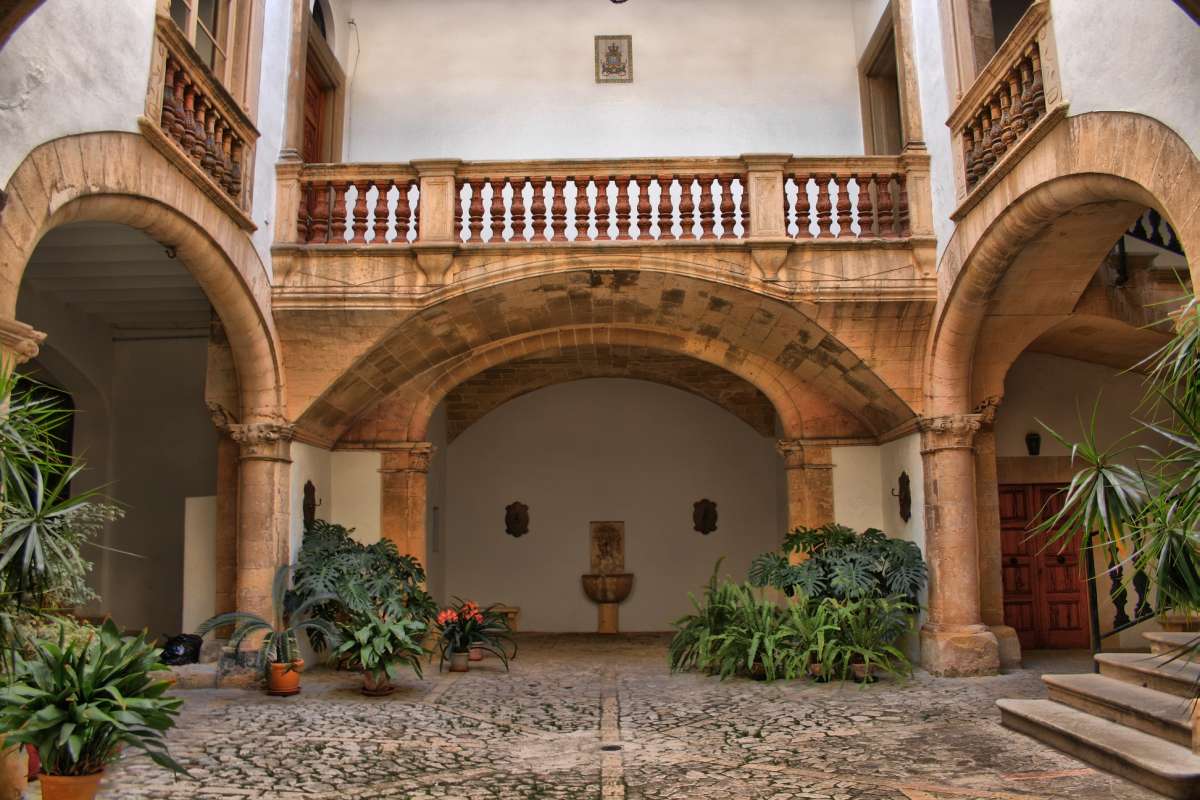
Palma, the City of Courtyards
Palma was built from the inside out. While the Mediterranean's port cities turned their walls and cathedrals toward the sea, the Mallorcan capital concentrated much of its wealth and identity in a more intimate gesture: the courtyard. Behind deliberately plain façades —bare stone, little ornament, a large doorway and not much else— families of merchants, nobles and clergy kept an open-air space that served at once as entrance hall, stage and statement of power. Today that space is still the best way to understand how people lived, and climbed, in the Palma of its golden centuries.
What is a Mallorcan courtyard?
A Mallorcan patio is neither a garden nor a mere hallway. It is a threshold: the point where the public street becomes, with no closed door in between, a private house. For centuries it was a semi-public space —somewhere you entered, waited and passed through— and a few still keep that character of a shortcut between two streets. That ambiguity between inside and out is what sets Palma's courtyards apart from the famous patios of Andalusia: this is not an enclosed floral oasis but a piece of civil architecture meant to be walked through and, along the way, admired.
The anatomy of a courtyard
Almost all of them share the same grammar. You enter through the portal forà, the great arch in the façade; you cross a zaguán, or entrance passage; and you arrive at the courtyard itself, open to the sky, ringed by columns with their capitals and by arches that, in the most refined eighteenth-century examples, are flattened almost to the point of impossibility to lighten the structure. From there a stately staircase —sometimes of imperial design, with a wrought-iron balustrade— rises to the gallery and, finally, to the piano nobile: the real house, reserved for the family. To read a courtyard is to read that sequence: the more theatrical the staircase, the higher its owner wished to stand.
How they changed over the centuries
The oldest surviving courtyards are Gothic, from the fourteenth and fifteenth centuries, often raised on Islamic-era foundations. Taste shifted over time, from medieval austerity to the Ionic capitals and flattened arches of the Baroque and the 1700s. The nineteenth century added a detail we now think of as essential but which arrived relatively late: the large green-leaved plants, placed to bring coolness and shade to a space that, in Palma's summers, worked as the cool lung of the house.
From five hundred to a hundred
Over time many courtyards lost their public role. Most are now privately owned and kept closed; some cannot even be glimpsed. So that this heritage would not vanish from view altogether, the city council went so far as to pay for the iron grilles on several of them, so that passers-by could at least look in from the street. By the counts used in popular walking itineraries, the city may once have had around five hundred courtyards; today perhaps a hundred survive.
Where to see them today
The good news for the traveller is that a number of them have found a second life open to the public. Can Balaguer is now a cultural centre; the Casal Solleric, a contemporary art space; and other manor houses hold archives and museums you can visit, courtyard included. If you would like to move from theory to a walk, we have gathered the six most beautiful manor-house courtyards in Palma in a separate post, with addresses and what to expect from each; you can also follow the Palma courtyards route suggested by the Balearic tourist board.
To wander the courtyards is, in the end, the most unhurried way to get to know Palma: a city that reveals its luxury not on the street front but one step further in, in the cool silence of a patio where time seems to pause. It is exactly the kind of Palma —urban, cultured and in no hurry— best discovered by staying in the heart of the old town, in neighbourhoods like Sa Calatrava.