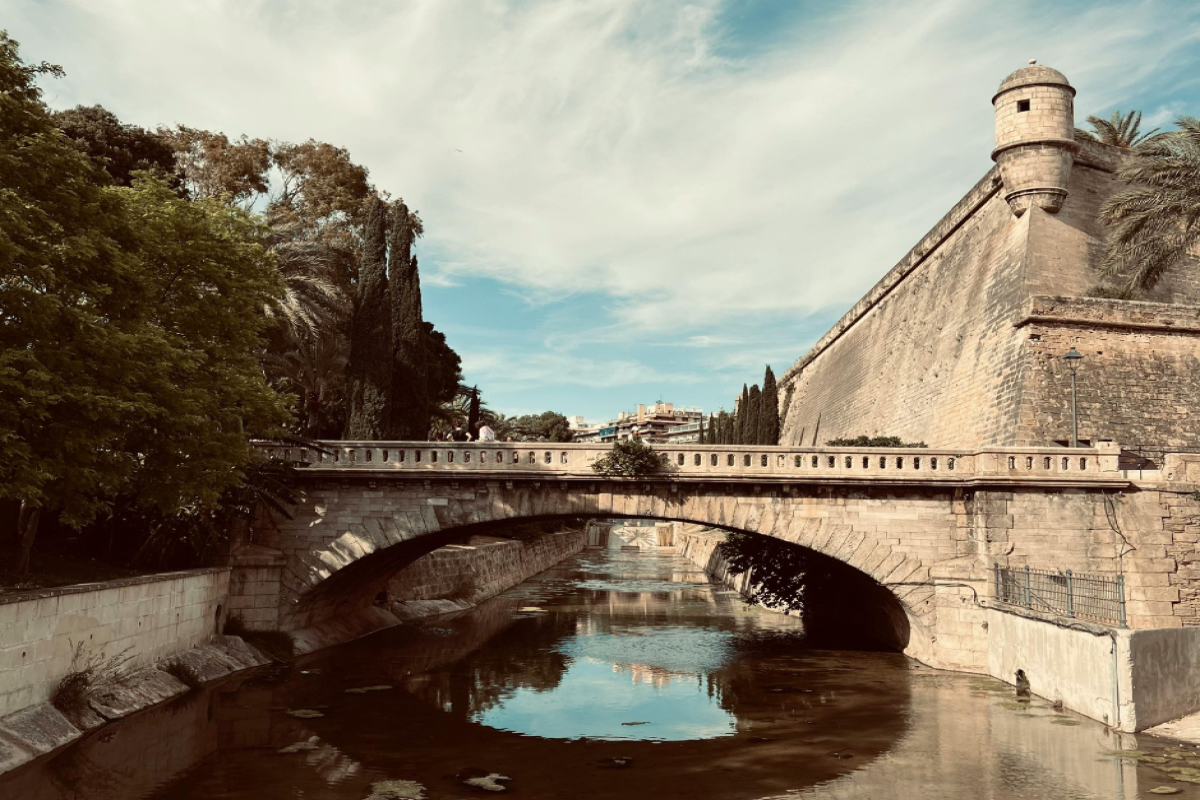
Palma city walls: how the city turned them into a promenade
In 1901, Palma City Council chose the plan that would bring down the city walls. It was drawn up by the engineer Bernat Calvet and carried a line from Virgil as its motto, “Felix qui potuit rerum cognoscere causas”: happy is the one who can know the causes of things. At the time, the cause seemed obvious. Palma was suffocating inside its own stone.
The Renaissance wall had been the most ambitious project in the city’s history. A ring of around six kilometres, with angled bastions and a moat 24 metres wide, designed to withstand artillery. Its seaward front was only completed in the early 19th century, just as that kind of defence was becoming obsolete. Back in 1885, the engineer Eusebi Estada had already called for its demolition on public health grounds: people lived crammed together and the city needed air.
From then on, the wall changed jobs. And that story can still be read on foot, from one end of the waterfront to the other.
Les Avingudes, the moat that became a street
The first trace is where you would least expect it. Les Avingudes, the busy ring road around the centre, follows the line of the old moat. One look at a map shows that its zigzag reproduces the geometry of bastions that no longer exist. Palma knocked down the walls but kept their outline.
Es Baluard, saved by its neighbours
Only the stretches closest to the sea, where the city had no room to grow, escaped demolition. Among them were two bastions, Sant Pere and Es Princep. Sant Pere very nearly did not survive. In the early 1960s it passed into private hands, and in 1963 its new owners tried to tear down part of the wall to build on the site. Public outcry stopped them, and the complex was declared a historic and artistic monument.
In 1997 the City Council handed over the site for a museum. Es Baluard Museu d’Art Contemporani opened on 30 January 2004, and its viewpoint is now one of the finest balconies over the Cathedral and the seafront. This autumn it is also showing an exhibition by the artist Luis Camnitzer, on until mid-January.
Ses Voltes and La Portella, the wall as public space
The project that changed Palma’s relationship with its wall began in 1983. The architects Elías Torres and José Antonio Martínez Lapeña proposed something that sounded radical at the time: rather than simply restoring the fortifications, they would turn them into public space. Their work unfolded over three decades along the waterfront, from Avinguda Antoni Maura to Ses Voltes, then on through La Portella, the Berard bastion and Plaça de Llorenç Villalonga.
The key was stitching levels together. The upper town, the moat and the sea were linked by stairways, ramps and terraces, so that an old military boundary became a place to walk through. Ses Voltes, the last section of wall ever built, is today a civic and exhibition space.
Parc de la Mar, water where the sea used to be
For centuries, the Mediterranean broke at the foot of the wall. Parc de la Mar opened in 1984 on land reclaimed from the water, and its great saltwater lake is no design whim. It marks where the shoreline once was and gives the Cathedral back the reflection it had lost. At one end, a ceramic mural reproduces one of Joan Miró’s last works. On 21 November, for the first time, the park will also host Palma’s Christmas lights switch-on.
Es Princep, the bastion returning to the city
The other survivor had a less kindly second life. In 1966, several blocks of military housing, seven and eight storeys high, were planned on top of the Baluard del Princep. They came to house more than a hundred families and hid the bastion for decades. In 1998 the Ministry of Defence and the City Council signed the agreement that returned the land to the city, and the blocks were eventually demolished.
The restoration stalled when the contractor carrying it out went bankrupt. This spring the remaining works were awarded: landscaping the moat, a stairway and bridge towards Porta des Camp, and a building to welcome visitors. It is the final piece of a project that began more than forty years ago. For the bastion’s military history, see our post on the Baluard del Princep, and for a short walk from the hotel door, Secret Palma from the City Walls.
The walls seen from above
Walked in this order, Palma’s waterfront tells the story of a century of decisions. What was torn down, what was saved just in time and what is still being recovered. Visit Palma’s tour of the old walls helps place each section on the ground.
As the light fades, the whole picture is clearest from above. From the ALMAQ rooftop, the lake, the stone ramparts and the Cathedral fall into place like an old city map, with the bay behind them.
Looking for more corners with a story? You’ll find more ideas for discovering the city on our blog.