All Saints’ Day in Palma: bunyols, rosaris and panellets
Mallorcan pastry chefs tell a story from the 17th and 18th centuries. Some people, they say, left instructions in their wills for small loaves to be placed on their graves, as food for the poor who passed through the cemetery. These loaves were called panets de mort, and that act of charity lies behind some of the sweets that fill Palma’s shop windows at the end of October.
In Mallorca, Tots Sants (All Saints’ Day) is a day of remembrance. Families visit the cemetery, bring flowers and gather around the table. This year 1 November falls on a Sunday. And like almost every festival on the island, it is also celebrated with food. Three sweets are essential.
Bunyols: the season starts with les Verges
Bunyols arrive first. Their season begins on the eve of Saint Ursula, the Nit de les Verges, when young men once sang serenades beneath balconies and were invited in for bunyols and sweet wine. As the local saying goes, “Per Tots Sants seran bunyols”: at All Saints, there will be bunyols.
The Mallorcan bunyol has little in common with an ordinary doughnut. The dough contains potato and often sweet potato. It is fried in very hot oil, shaped with a hole in the middle and finished with a dusting of sugar. Pastry shops also sell versions filled with custard, cream or chocolate truffle. In these weeks, pop-up stalls appear around the city, frying them to order, and you can smell them a street away.
Rosaris: a gift from godparents
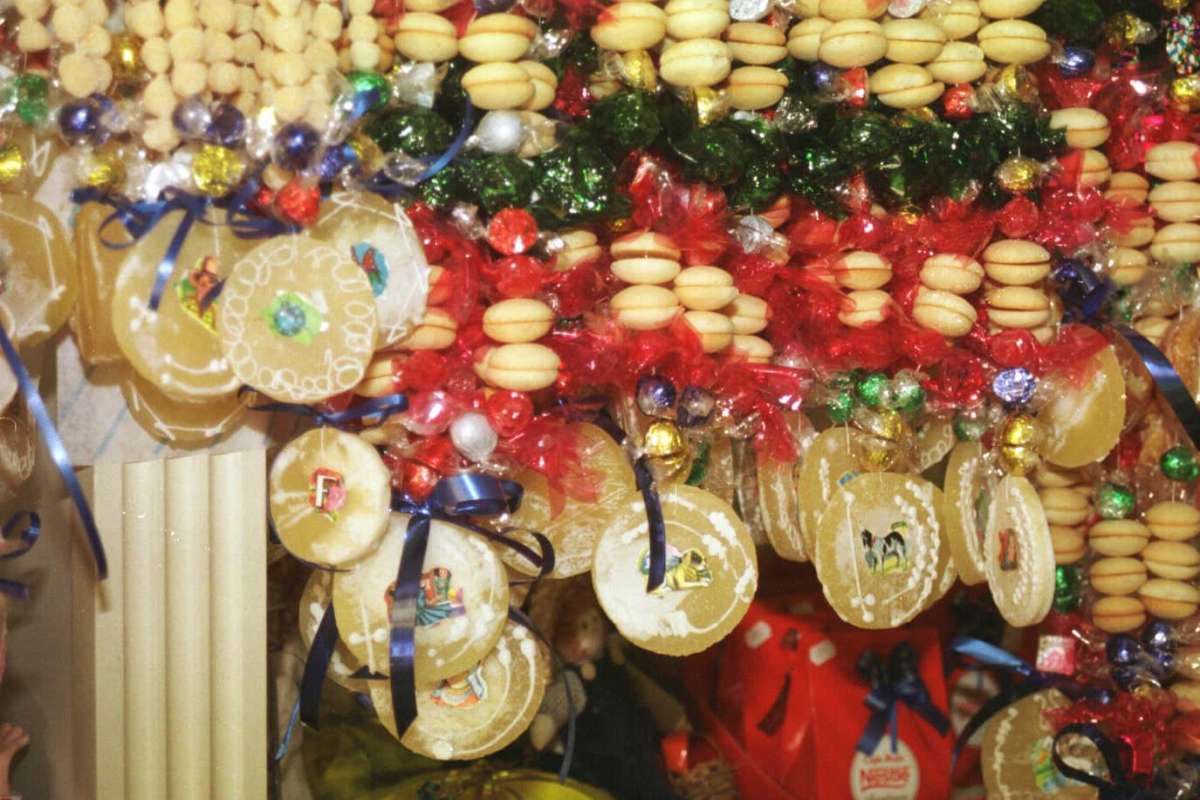
The most distinctive All Saints’ sweet is also the most typical of Palma. The Alcover-Moll dictionary describes the rosari as a string of chocolates and confectionery given to children at All Saints. It notes that the custom belongs especially to Palma and spread from here to the rest of the island, as explained in this history of the rosaris.
Traditionally, godparents gave them to their godchildren. Every piece had a meaning: the Hail Mary beads were panellets and the Our Father beads were candied fruit. At the centre hangs the patena, a large medallion of carabassat, candied pumpkin, which shines like old gold. For generations, Palma’s children walked the streets with their rosaries hung around their necks.
The custom dates back to the 18th century and is still alive, though it has changed. Pumpkin patenas are increasingly hard to find, so many bakers now make them from chocolate. There are rosaris made of biscuits for the youngest, others of chocolates and even of sweets. You can see how today’s bakers make them in this report from the Majorca Daily Bulletin. One thing never changes: rosaris are made only for these days, and once the festival is over they vanish from the counters until next year.
Panellets: almonds, pine nuts and patience
Panellets came from Catalonia, but Mallorca has made them its own. The base is simple: ground almonds, sugar and lemon zest, sometimes with egg yolk. The classic version is rolled in pine nuts before baking. From there, every bakery plays with flavours such as coffee, coconut, orange, strawberry, quince or pistachio. The best are made with Mallorcan almonds, and you can taste the difference.
They are eaten with family after lunch on the 1st. Tradition pairs them with a sweet wine, and an island moscatel suits them perfectly.
Where to buy them in Palma
The historic bakeries in the old town are the best places to experience the tradition. At Forn Fondo, on Carrer de la Unió, they make almost every part of their rosaris themselves: marzipan balls, chocolates, paciència biscuits and the chocolate patena. Their panellets come in a long list of flavours. Forn del Santo Cristo builds its rosaris with candied pumpkin and chocolates, with chocolate coins as the patena. Pastisseria Pomar, on Carrer de Manacor, still makes them with panellets, chocolates and fruit, as gifts for grandchildren and godchildren.
A practical tip: handmade rosaris are limited and sell out. It’s best to order ahead and check each bakery’s opening hours, as this year the festival falls on a weekend.
A tradition that lives alongside Halloween
In Palma, All Saints shares the calendar with Halloween. In shop windows, fondant pumpkins sit next to the traditional rosaris. Bakers admit that many young families have embraced the newer celebration, but the contrast has its charm. It’s rare to see so clearly how a city chooses which customs to keep.
From bakery to bakery
All Saints’ sweets call for an unhurried stroll through the old town, from bakery to bakery with a paper bag in hand. To continue the food trail, here is our pick of Palma’s most authentic tapas bars. And to end the afternoon, take in the bay from ALMAQ, the Es Princep rooftop, as the November light fades over the Cathedral.
Discover more ideas for enjoying Palma and Mallorca this autumn on our blog.