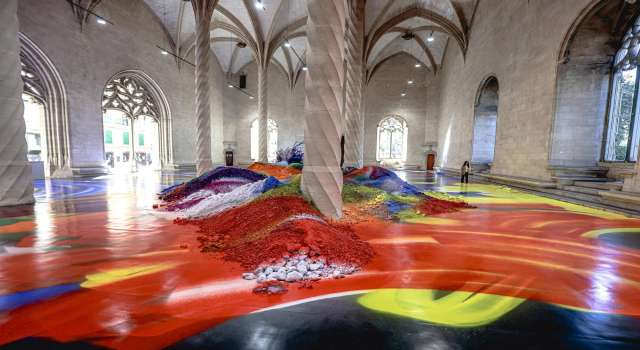
Arrels: Katharina Grosse transforms La Llotja in Palma
A seven-tonne pine tree lies on the floor of La Llotja in Palma. It has fallen, its roots exposed, and it is painted in colours no forest has ever known. Around it, dyed earth spreads across the floor and climbs the columns, as if the building itself had begun to put down roots. This is Arrels, the intervention through which German artist Katharina Grosse has turned the old merchants’ exchange into a landscape you walk through rather than look at. It runs until 31 January 2027.
A monument that cannot be touched
La Llotja is one of the great works of Mediterranean civil Gothic. The Mallorcan architect Guillem Sagrera built it in the 15th century as the seat of the merchants’ guild, in a Palma whose life faced the harbour. Inside, six spiralling columns twist up towards the vaults like stone tree trunks. It is hard to imagine a building better suited to receiving a tree.
That is the first key to the work. Grosse could not drill, nail or paint the stone, because the monument is untouchable. So she did the opposite of what she is known for. Instead of covering the architecture in colour, she built a model of a landscape inside it and let colour bind everything else together.
Forty tonnes of colour
The numbers impress before you even step inside. As the local paper Ultima Hora reported on opening day, the installation weighs 40 tonnes, and at its heart is the seven-tonne painted pine. The rest is coloured earth that covers the floor and climbs bases, columns and arches.
The effect is disorienting in the best possible way. As Es Baluard Museu, the exhibition’s co-producer, describes it, Grosse uses colour to unify disparate elements and alter perception. The boundaries between painting, sculpture and architecture blur, as do those between wall and floor, viewer and participant. There is no single spot from which to see “the work”. You have to walk it, circle the tree, look up to the vaults and back down to the ground.
The title sums it up. Arrels means “roots” in Catalan. These are the roots of an uprooted tree, and also those of a building that has stood anchored by the sea for almost six centuries. The artist herself framed it this way at the launch: the ephemeral nature of her work against the longevity of La Llotja.
Who is Katharina Grosse?
Born in Freiburg im Breisgau in 1961, Grosse divides her time between Berlin and New Zealand. For over thirty years she has been taking painting off the canvas. Her usual tool is the spray gun, and her surface is almost anything: walls, floors, entire buildings. Fallen trees have appeared in her work before, as in I Think This Is a Pine Tree (2013). She has exhibited at the Centre Pompidou-Metz, Berlin’s Hamburger Bahnhof, MoMA PS1 in New York and the Venice Biennale. The show is curated by David Barro, director of Es Baluard, which co-produces it with the Balearic Government.
La Llotja as a contemporary art venue
Arrels is the latest chapter in a programme that began in 2023, when the Balearic Government reopened La Llotja as an exhibition space. Pedro Cabrita Reis, Julian Opie, Jaume Plensa and Joan Miró have all shown here before. According to the official Llotja website, the building welcomed more than 900,000 visitors in its first two years as a venue. If you want to follow the thread, our route through the old town’s contemporary art galleries gathers the addresses that complete the visit. Our post on the Nit de l’Art tells how Palma has spent thirty years opening its doors to the art of today.
Visiting
La Llotja is at Plaça de la Llotja, 5. It opens from 10.30 am to 1 pm and from 4 pm to 9 pm. From November onwards, the afternoon session closes at 7 pm. The exhibition runs until 31 January 2027. It is worth going unhurried: the light through the windows changes a great deal between morning and afternoon, and the installation’s colours change with it.
From La Llotja to the rooftop
For guests staying in La Calatrava, the plan draws itself. La Llotja is a stroll from Es Princep: you follow the old city walls and pass beneath the Almudaina and the Cathedral. Arrive at 4 pm, when the afternoon session opens, and walk back along the sea. You’ll be in time to watch the sun go down from ALMAQ, the Es Princep rooftop, with the bay as a backdrop and your head still full of colour.