Binissalem wineries: a wine day trip from Palma
In 1931, a young man from Binissalem decided his family’s wine deserved more than a barrel. José Luis Ferrer Ramonell founded the Vinícola de Binissalem, and Mallorcan wine began to travel in bottles. Almost a century later, his winery still stands at the entrance to the village, and the trip to visit it starts in the heart of Palma, on a train platform beneath Plaça d’Espanya.
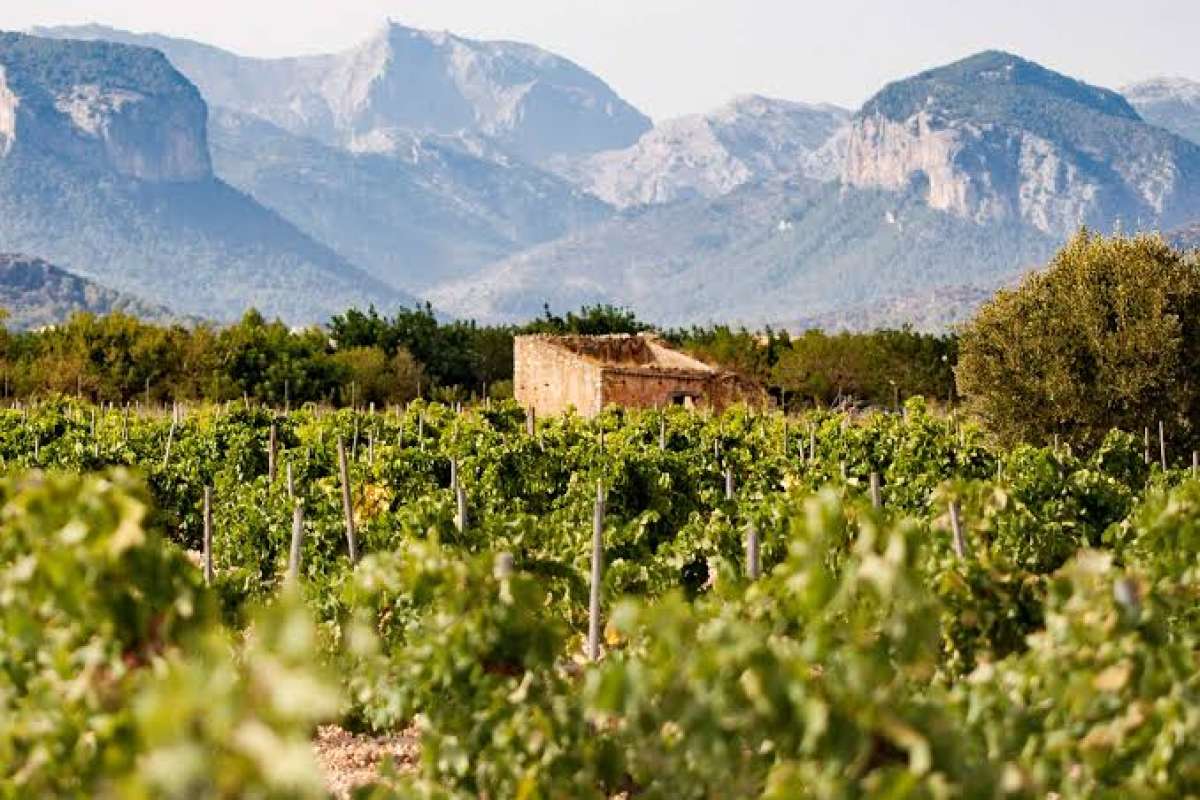
October is the moment to go. The harvest is safely in the tanks, the summer heat has eased, and the Raiguer, the strip of farmland at the foot of the Serra de Tramuntana, turns to ochre. The wineries of Binissalem are best explored slowly, glass in hand, with the afternoon ahead of you.
The islands’ first wine appellation
Mallorcan wine has an ancient pedigree. Pliny the Elder compared Balearic wines with the finest in Italy, and in the late 19th century the island shipped much of its harvest to a France devastated by phylloxera. Then, in 1891, the vine pest reached Mallorca and all but wiped out its vineyards. Recovery was slow, and Binissalem ended up leading it.
In 1990 the Binissalem Denominación de Origen was born, the first protected wine region in the Balearics. It started with three wineries and around 300 hectares of vines. Today it covers five municipalities (Binissalem, Consell, Santa Maria del Camí, Santa Eugènia and Sencelles) and champions two grapes rarely found beyond the island: the red Manto Negro and the white Moll, also known as Prensal Blanc. Ordering a Manto Negro in Binissalem is a little like ordering Nebbiolo in Piedmont. You are drinking the place.
A winery of firsts
The story of Bodegas José L. Ferrer reads almost like a summary of modern Mallorcan wine. It was the first on the island to age wine in oak barrels, the first to bottle it for sale and the first to export it, initially to Switzerland and later to the United Kingdom and the United States. It also made Mallorca’s first rosé. The third and fourth generations of the family run it today, and all the vineyards they own are farmed organically.
The tour takes in the historic cellar, with its concrete tanks from the 1930s, and the modern winery, before ending in the tasting room. Shorter visits last around fifty minutes; longer ones pair wines from the Veritas range with chocolate. Booking ahead is essential, as it is at nearly every winery in the appellation.
Can Sabater, where wine became literature
Binissalem offers more than a tasting. Its old centre, built in honey-coloured local stone, has been a protected historic site since 1983, and many of its grand houses were raised in the 18th and 19th centuries on the proceeds of wine.
The most eloquent of them is Can Sabater, now the Casa Museu Llorenç Villalonga. Villalonga, one of Mallorca’s great 20th-century writers, spent his summers here and much of the Spanish Civil War. His best-known novel, Bearn, is a portrait of the slow decline of the island’s landed aristocracy. The house still keeps its 18th-century wine vats and the room where grapes were once trodden by foot: literature and harvest under one roof.
Getting there without a car
Trains run by Serveis Ferroviaris de Mallorca leave from the Estació Intermodal, Palma’s main station beneath Plaça d’Espanya, and reach Binissalem in around thirty minutes. It is the most civilised way to make the trip, since nobody has to skip the second glass. From the station, the village is easily explored on foot.
A couple of practical tips. Book your winery visit in advance and check that day’s opening hours, as some, including Ferrer, close earlier on Sundays. And keep the afternoon free. The real pleasure of Binissalem is its pace: the square, the bell tower, a long lunch with no clock in sight.
Back in Palma
The train brings you back to the city in time for the final act. From the Calatrava neighbourhood, October light falls across the bay and the Cathedral, and ALMAQ, the Es Princep rooftop, stays open until sunset. A fitting end to a day that began among the vines.
For more ideas on discovering Palma and Mallorca this autumn, explore our blog.