Palma’s Food Markets: l’Olivar, Santa Catalina & Pere Garau
Before its cathedrals and its palaces, a Mediterranean city built its markets. For centuries the covered food market was the true centre of urban gravity: the place where the countryside entered the city, where freshly landed fish met inland vegetables, and where news, prices and conversation were exchanged along the way. Palma is no exception. Walking its markets is still one of the most honest ways to read the city from the inside, neighbourhood by neighbourhood, far from the monumental circuit.
What makes Palma unusual is that it never concentrated its market life in a single gastronomic temple, as other capitals have done. It spread it out. Each market has its own character, its own hours and its own social geography, and together they draw a far truer map of the city than any guidebook. Here is a route for exploring them with a discerning eye.
Mercat de l’Olivar: the great market in the centre
A few steps from Plaça d’Espanya, between the square and the shopping street of Sant Miquel, the Mercat de l’Olivar is Palma’s flagship food market. Opened in 1951 — its name recalls the olive groves that once covered the area — and thoroughly refurbished in 1997, it occupies a building of two perpendicular halls housing more than a hundred stalls over two levels.
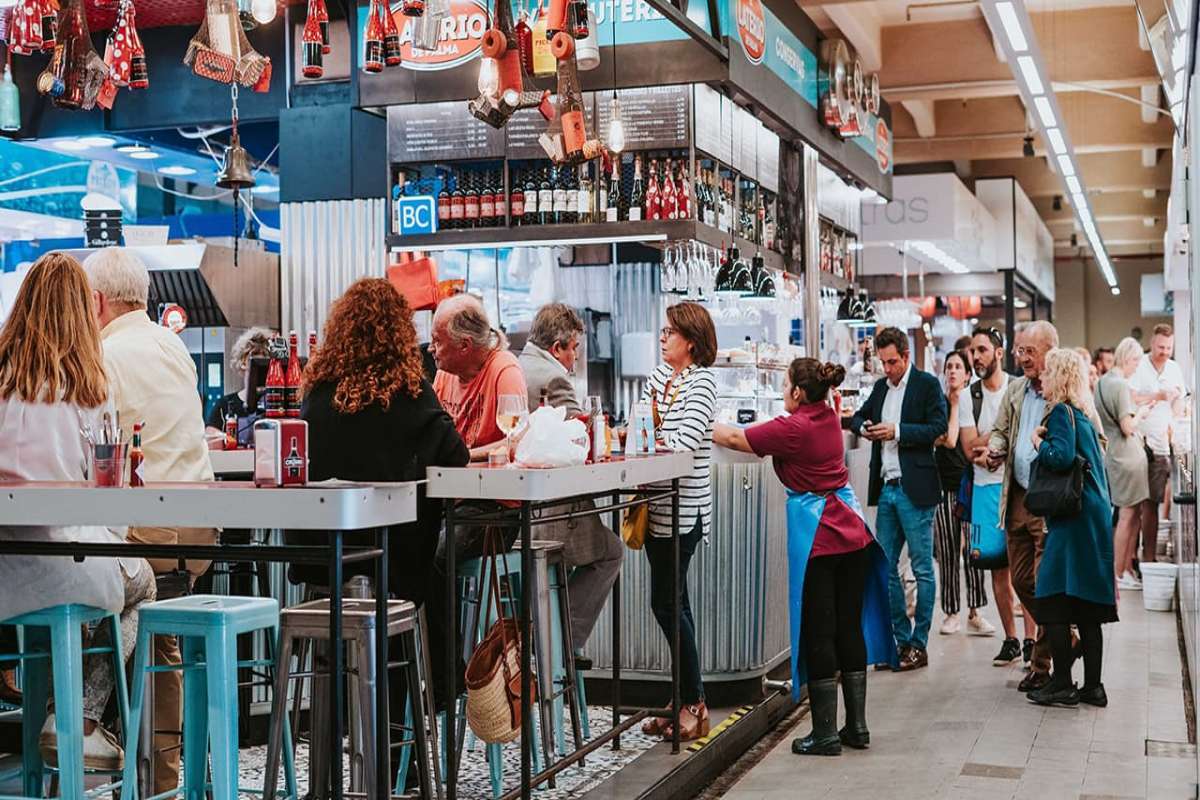
Here the traditional market — fish and shellfish of the day, meat, seasonal fruit and vegetables, cheeses, cured meats such as sobrassada — sits alongside a gastronomic floor designed with visitors in mind: counters for tapas, oyster and cava stands, and restaurants that will cook on the spot whatever you have just bought downstairs. It opens Monday to Saturday in the morning (with partial Friday afternoon hours), the food area staying active into the early afternoon. It is the most accessible market and the best starting point for a first visit.
Mercat de Santa Catalina: the oldest, a step from the sea
The present building of the Mercat de Santa Catalina dates from around 1920, making it the oldest market in Palma, predating both l’Olivar and Pere Garau. It stands at the heart of Santa Catalina, the old fishermen’s quarter that grew up outside the walls beside the Es Baluard bastion, and which still keeps the Modernista façades raised in the late nineteenth and early twentieth centuries by the indianos returning from Cuba.
With around fifty stalls, it keeps the pulse of a neighbourhood market — fish, meat, local fruit and vegetables — yet today it is also one of the liveliest gastronomic meeting points in the city. One detail worth knowing: some of its bars let you buy fresh produce at the stalls and take it to the grill to be cooked on the spot. All around, the neighbourhood prolongs the experience with specialty coffee, vermouth bars and restaurants, and the seafront promenade is just a few minutes away on foot.
Mercat de Pere Garau: the most local of all
East of Las Avenidas, away from the old town, the Mercat de Pere Garau is the most genuinely local market in Palma. Its covered hall, a food market since 1943, gathers around a hundred permanent stalls; but its hallmark is the open-air market on Tuesday, Thursday and Saturday mornings, when more than two hundred stalls spread through the streets surrounding the square.
It is the only market in Palma where the island’s village farmers still sell directly what they grow — hence its prices — and also the only one where small live animals, such as poultry, rabbits or birds, are still sold in a dedicated area. All of this in a deeply multicultural neighbourhood, where South American grocers coexist with Chinese restaurants and long-standing local taverns. It is not a market designed for tourists, and that is precisely why it is worth the visit.
The curiosity: the organic market at Plaça dels Patins
To finish, a stop few visitors know. On Plaça del Bisbe Berenguer de Palou — which locals call Plaça dels Patins — the Mercat Ecològic de Palma sets up every Tuesday and Saturday morning, and has done since 2010. It is not a conventional food market but a direct-sale one: there are no middlemen or resellers here, only organic farmers selling what they have grown in their own fields — something that no longer exists anywhere else on the island.
Around twenty producer families keep the project going, driven by associations of producers and consumers together with the City Council. What you find there changes with the season — the best way to understand what the Mallorcan countryside truly yields at each time of year — and ranges from local-variety fruit and vegetables to spelt bread, cheeses, honeys, oils and native seeds. A brief visit, but a revealing one for anyone wanting to grasp Mallorca’s pantry in its purest form.
How to experience them from Es Princep
From the La Calatrava neighbourhood, where Es Princep stands, the central markets are within an easy walk: l’Olivar and Santa Catalina are perfect for an unhurried morning, while Pere Garau or Plaça dels Patins reward those who want to step off the usual circuit. The best time is always first thing in the morning, when the produce is untouched and the rhythm is that of the real city.
And if the idea is to enjoy Mallorca’s produce without the early start, the journey ends at home: on the hotel rooftop and in its restaurants, those same ingredients — Mediterranean fish, seasonal vegetables, island olive oil — arrive already turned into cuisine, with the views of Palma as a backdrop.