Palma's trade streets: the guild names hidden in the old town
In 1576, a survey of Palma's homeowners captured a city that lived by the work of its hands. It recorded 237 paraires preparing wool, 110 assaonadors tanning hides, 106 shoemakers, 72 carpenters and 32 silversmiths. Nearly four and a half centuries later, most of those workshops have gone, but many of their trades are still written on the street corners. Look up at the signs in the old town and you'll find that Palma's street map still traces the guild city it once was.
A city organised by trade
In medieval Palma, as in Barcelona or Valencia, craftsmen of the same trade tended to cluster on the same street. The workshop and the shop were usually one and the same, and raw materials had to be close at hand. The guild, the body that brought together the master craftsmen of each trade, set standards of quality, prices and apprenticeships. Over time, the habit of naming a street after the work done there became its official name.
Part of that memory faded over the years. Authentic Catalan forms such as Corderia were only restored with the standardisation of the city's street register in 1990, as this Ara Balears feature (in Catalan) recalls. For readers who want to dig deeper, the reference work is Els carrers de Palma by linguist Gabriel Bibiloni. It traces the naming history of every street in the municipality and won the Obra Cultural Balear's Miquel dels Sants Oliver prize.
La Calatrava, the neighbourhood that named a trade
The most unusual case lies in Es Princep's own neighbourhood. For centuries, La Calatrava was the tanners' quarter. In Mallorca, tanners even came to be known as calatravins, as the Gran Enciclopèdia Catalana notes. Here the usual order is reversed: rather than a trade naming the street, the neighbourhood lent its name to the trade.
The traces remain in the street plan. Just a short stroll from the hotel runs Carrer dels Blanquers, named after the craftsmen who stripped the hair from hides and left them "white" before the final finishing. During construction, the remains of an old tannery were found beneath Es Princep's foundations and are now part of the building, as we explain in Secret Palma from the city walls.
Paraires, Corderia, Argenteria: a trade on every sign
Carrer dels Paraires. The paraires were the craftsmen who prepared wool before it reached the loom: washing, carding and combing it. In 16th-century Palma it was the most numerous trade of all, a sign of how much the wool industry mattered to the island's economy. Today, near Sant Nicolau, the carders have given way to design boutiques and vintage shops, but the street keeps something of its workshop feel.
Carrer de la Corderia. This was the street of the rope-makers, who twisted cords and ropes for the port, the countryside and the home. It is one of the few places in Palma where the trade and the street sign still match. At number 13, Mimbrería Vidal still sells basketwork, cord and chairs with woven seats. Of the rope workshops operating in the 16th century, it is practically the only one still standing.
Carrer de l'Argenteria. Between Bosseria and Santa Eulàlia, the silversmiths' street is still home to jewellers. Its short branch towards Plaça d'en Coll, Carrer dels Argenters, is a reminder that street maps get rewritten too: according to Bibiloni, until 1863 it was known as Carreró d'en Cassola.
When the shop names the street
Sometimes it works the other way round. The Forn de la Glòria, on the street of the same name, has been documented as a business since 1717. Its owners trace its origins even further back, to the 13th-century Llibre del Repartiment. The bakery occupies an 1870 building, remodelled in 1903 with Modernista details, and still uses its original wood-fired oven. That the street took its name from the bakery, and not the other way round, says a great deal about its place in the city. Its story is told on Emblemàtics Balears.
Places like this are why Palma City Council keeps a catalogue of Emblematic Establishments, which reached 135 businesses in 2026. To qualify, a business needs at least 75 years of trading or a distinctive character recognised by a technical committee. A good starting point is Visit Palma's route through the city's emblematic shops.
Reading the city on foot
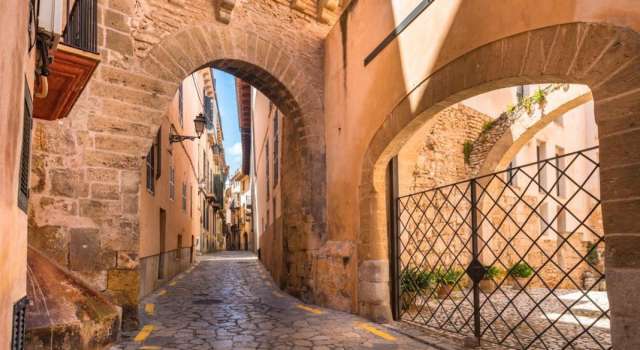
The best advice for this walk is to take your time and look up. Many street signs in the old town give the name in Catalan and sometimes a short note on its origin. Every corner is a small lesson in economic history: where wool was worked, where silver was sold, where the air smelled of freshly tanned leather.
The Spanish word for guild, gremio, comes from the Latin gremium, meaning "lap": the place where you are sheltered among your own. It's a fitting image for ending the walk back in La Calatrava, among the old tanners' streets, with a cocktail at Gremium, the cocktail bar at Es Princep.
Curious for more of Palma's history? You'll find more routes and stories about the city on our blog.